Each day purpose to learn something new; something life-enriching; something that makes you a better person. Help is sometimes needed to point you in the right direction, given the mass of knowledge available today. This is where Susan Wise Bauer comes in. She has written a book titled "The Well-Educated Mind" that gives you a game plan. The first section of the book goes over the why's and whatfor's and howto's of reading classic literature. Then she dives into a selection of books themselves. All the choices have been made for you. There is no excuse not to begin the process of self-education.
Why then have I had this book for several years and am no further ahead than before I got it? Because the book that she starts with is Don Quixote. If you know anything about this book you know that it's just plain weird. I've tried and tried to read it but it's just too....weird. And being the linear person that I am, if I couldn't read the first book on the list, I couldn't move on. Well, I'm over it. I'm turning the page and going on to The Pilgrim's Progress (which just happens to be one of my most favorite books of all time - isn't that fortunate?).
The Pilgrim's Progress is also available as a recent movie, but I'll hold off watching it till I've reread the book (as I always insist on for my children).
Showing posts with label education. Show all posts
Showing posts with label education. Show all posts
Monday, February 2, 2009


Saturday, January 31, 2009
Let your brain bloom

It must be said that I read a lot of children's books. For many years that has even meant picture books (I still read those - a good book, is a good book!). Now, though, it's mostly upper elementary and junior high level. There are several reasons for this.
One is that I like to preview material for my kids to see if it's something that I either know or hope will interest them. Or to check if the content is "suitable".
Another reason is that when checking out a new topic of interest for myself, often reading a book that is geared to younger children will explain it in simpler language. You can get the big picture first, and then go on to the finer details.
And then sometimes the book just has an appealing storyline - no matter your age.
These books have their place. There comes a time, though, when you must read at a deeper level. Here's where Bloom's Taxonomy can help out.
Benjamin Bloom came up with a structure of "knowing levels", from the basic knowledge level through comprehension, application, analysis, synthesis and ending with evaluation. Different groups over the years have used his levels for their own purposes, such as teachers making exam questions. But they can be helpful to individuals who are intent on self-education as well. After you have become familiar with the facts in an area of self-discovery, challenge yourself with the higher levels to see how much thinking is going on. You don't just want to be able to win a place on "Are You Smarter Than a Fifth Grader?" or "Jeopardy". You want to have a relationship with the people you are reading about. You want to know why they behaved the way they did, what the implications of their behavior were and ultimately, you want to see the hand of God moving through history.
Thursday, January 15, 2009
Peace amongst the pandemonium
In the midst of a totally hectic day spent running around, I had the opportunity to halt everything and immerse myself in the beauty of Mozart's classical music. Performed by a top-class orchestra, no less. Even though we were surrounded by a theatre full of wiggly children, the excellence of the musicians and the exquisiteness of the timeless pieces managed to transport me for a short time beyond the hustle and bustle of everyday life.
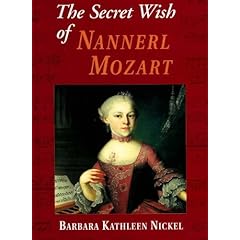
The Secret Wish of Nannerl Mozart by Barbara Nickel is an interesting take on Mozart's life, told from the perspective of his sister. This is a book for older elementary children, but I enjoyed reading it myself. Three stars.
Sunday, January 11, 2009
Things are not as they first appear
Things are not as they first appear. This is a familiar phrase that Malcolm Gladwell in Outliers proves to me is true. Assumptions are probably wrong; digging deeper will come up with a more complex web of interactions than is apparent on the surface.
On the surface it appears that outliers - those who rise to the top of their chosen field - may have gotten there by way of their sweat and hard work. And to a certain extent this is shown to be true. But in fact, it is also a mixture of lucky breaks, timing, advantages, and circumstances particular to that person that combine together with his or her hard work, strength and presence of mind to seize opportunities that make that person successful.
 I definitely give this book a thumbs up and would recommend it. The value in a book, though, beyond it's pleasure factor - the enjoyment of reading the book - lies in the questions: Has it made a difference in my life? Am I a better person for having read the book? Will I now approach life differently?
I give Outliers a three star rating (see sidebar for explanation).
Take-away points:
On the surface it appears that outliers - those who rise to the top of their chosen field - may have gotten there by way of their sweat and hard work. And to a certain extent this is shown to be true. But in fact, it is also a mixture of lucky breaks, timing, advantages, and circumstances particular to that person that combine together with his or her hard work, strength and presence of mind to seize opportunities that make that person successful.
 I definitely give this book a thumbs up and would recommend it. The value in a book, though, beyond it's pleasure factor - the enjoyment of reading the book - lies in the questions: Has it made a difference in my life? Am I a better person for having read the book? Will I now approach life differently?
I give Outliers a three star rating (see sidebar for explanation).
Take-away points:
- look for opportunities that can be a jumping point to future success
- work hard!
- nix summer vacation for students
Tuesday, January 6, 2009
Book of the week?

One of my favorite people in the whole world is Susan Wise Bauer. She is smart, witty and so down-to-earth, in spite of being a well-known author. I was totally in awe of her accomplishments (well, I guess I still am), but after I actually saw her in person she became such a ....mom, just like me. She just has that certain something that has allowed her to be very productive and successful in spite of having some similar responsibilities as me (such as numerous children, homeschooling them, household stuff to do etc.)
Which leads me to her challenge for 2009. She's joined a group which plans to try and read one book a week for 52 weeks. For her that means unwork-related books, because she reads a number of research books as week. (And writes her own books at the same time - you see why I want to be this woman)
My nature is to jump on this bandwagon. One book a week...easy-peasy. I used to be able to pull this off no problem. Until I took up knitting. Add a crazy obsession with manipulating sticks and string for hours on end to an already full schedule of schooling, children's ministry and homemaking and there isn't a lot of free time left over for reading numbers of books a week. That's why I've taken up listening to audio books.
So I'm not offically saying that I'm going to read 52 books in 52 weeks. But....here's book number one.
OUTLIERS by Malcolm Gladwell
This book is so exciting! If you have read any of his other books (The Tipping Point, Blink) and enjoyed them, you'll like this one as well. He is a man who can see patterns (another personality characteristic that I covet, but don't have). In Outliers he examines success to see what factors make a person successful. As the book proceeds he shatters many accepted ideas of what these factors might be by researching successful people and trying to find some common ground. I hesitate to say too much because it was just fascinating for me to read it for myself and I don't want to take away that pleasure from anyone.
One that I will divulge is the 10,000 hours theory. It appears that on average, to become a master or world-expert at something you don't necessarily have to have high IQ or an exceptional skill at it. You must just put in at least 10,000 hours doing it. Which roughs out to about 10 years. I have to admit that I got excited thinking about that 10,000 hours concept. Hmmm....manageable? Till he added the 10 years part. A bit mind boggling to think in those terms when you've already passed the half century mark. All the people that he used to determine his figures began their journeys when they were young and unattached and able to devote almost 24/7 to their passions.
Nevertheless, it is something to think about. It's more about the time that you put into a passion than the innate ability you have to do it that determines where you will go with it.
The chapter that will be of special interest to parents deals with the factors that mean the difference between success and failure even when starting with the same baseline of intelligence. It comes down to family interaction and involvement, people. Of course, we all know that. But maybe having it down in black and white will provide the discipline needed to be intentional about following through.
Wednesday, March 21, 2007
A time of introspection

The scene outside is bleak and dreary, but inside the heater pumps warmth into the room as I clean, sort, organize and rearrange. In the process I've come across my years and years of journals. It's important, I think, to occasionally read what you have jotted down in a journal. It brings a time of introspection - you can see where you've been and where you had hoped to be. It might bring on an "aha" moment or a "right, I'd forgotten about that". In this hurried world, layer upon layer of busy-ness can cloud our focus and keep us running around like a chicken with its head cut off (and I know from where I speak on the headless chicken concept). Spending some time reflecting on what has been important to you in the past can clarify your mind to see what needs to be weeded from your present life.
Spring is a time when I start planning for the following educational year with my children. I came across some quotes about education that I had jotted down many years ago and I'd like to share them here. I hope through these inspirational words that I can find myself back on track to creating a positive learning environment for my children that best acknowledges their God-given gifts and talents and the direction that He is leading them.
"We must keep in mind that education is nothing if it fails to teach beliefs and skills that prepare us to live successfully within our times."
"It's really important to look at the wrong answers. It is from them that we best learn about our mistakes and how to correct them. Mistakes are much more important than right answers."
"In real learning, however, mistakes are essential. A person rarely has the right answer the first time around, so learning is accomplished through trial and error."
"Education leaves out the crucial process of questioning what you don't know."
"Learning begins with questions - questions the mind forms in response to the world and events."
"School treats all the same, gives all the same, produces all the same."
"Education is preparing your child to live out the individual and personal calling of God."
Monday, January 22, 2007
Another reading attempt aborted

Well, I really did my best to continue with "What Video Games Have to Teach Us about Learning"....but to no avail. It's just over my head and I don't have the time to try and make sense out of if. Basically, I BELIEVE he's saying that video games enhance learning because of the way that they allow you to become a part of the environment of the game. Also, as you continue to play them over and over attempting to win each level you "learn as you go", teaching the skills of building on basic knowledge to acquire more. He criticizes the school system for lagging behind in this area, often using methods that are more skill and drill than innovative.
In the meantime I finished a book that I can't recommend called "Girl in a Red Tunic". This is a medieval mystery by Alys Clare. It was a little too graphic for my taste - I had to edit a number of parts by "sweeping the page". Too bad - the storyline was interesting and it WAS a good read for the plot and historical value. I'll try one more of her books, but if that seems to be the way Clare writes I'll give her a pass from then on.
Friday, January 19, 2007
Reading thoughts

I started a book last night called "What Video Games Have to Teach Us about learning and Literacy" by James Paul Gee. As a concerned mother I'm always wondering if my children are spending too much time on the computer and other media sources. So I read everything I can on the subject. After reading only part of the introduction I was feeling very overwhelmed. Maybe I was tired (it was evening, after all), but I was starting to feel anxiety radiate from my stomach to my outer limbs as I tried to decipher his sentences. He's a professor of reading at a university in the States and I think you need to be another professor to understand what he has to say. Basically, I am getting the impression that he is in favor of the learning that goes on when playing video games. He has some interesting ideas about reading and literacy that confirm what I have heard from other sources, most recently Susan Wise Bauer. Reading is more than just decoding the words. Your life experiences, background, culture etc. all play into what you get out of what you read. I am intrigued enough by the little that I got out of my journey into his book last night to attempt to try again today. If I get bogged down I will cut to the chase and skip to the ending chapters to see how he concludes the whole thing. I hope that I don't learn that I should be playing video games for brain development!
Subscribe to:
Posts (Atom)